
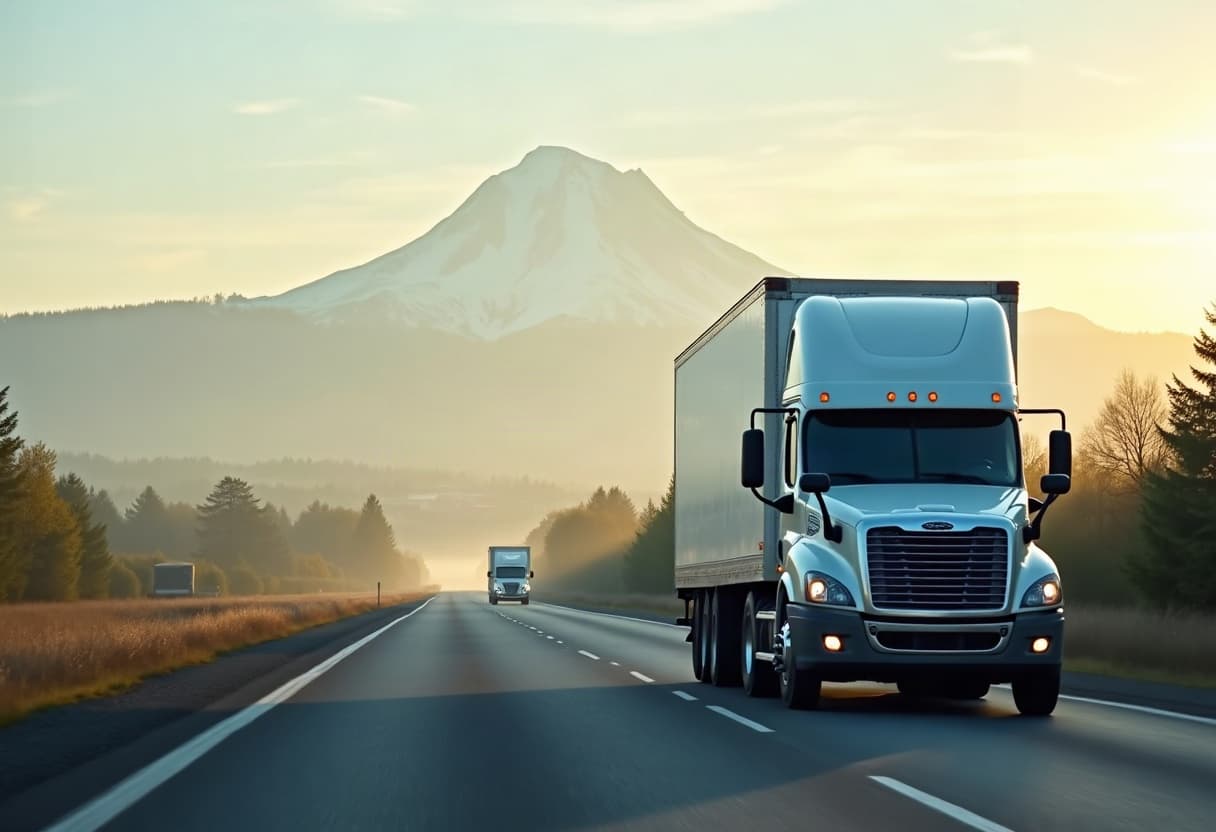
All Seasons Transportation: Year-Round Kent Freight
Freight does not take the winter off. A container discharging at the Port of Seattle in January still needs to reach a warehouse in Kent. A pallet of building materials ordered in July still needs to reach a job site in Spokane. A refrigerated load of produce picked in August still needs to roll from Wenatchee to a distribution center in the Kent Valley. The trucks keep moving through all of it — or they do not, and the shipper pays for the gap.
"All seasons transportation" is the shorthand for a regional carrier that runs freight year-round without dropping capacity when the weather turns or the market tightens. For a Kent, WA shipper, this is the actual job. This post breaks down what year-round freight looks like from a Kent carrier's perspective — how the seasons change the work, when capacity gets scarce, and what to expect from a carrier that holds the line through every Pacific Northwest season.
What "all seasons transportation" actually means
The phrase gets used loosely. A real all-seasons carrier is one that can answer four questions about the same load, in any month:
- Will the truck make it through the pass? Chains on the tractor, driver trained for winter conditions, and a dispatcher watching WSDOT reports before the truck leaves the yard.
- Is the equipment rated for the season? Reefers that hold temperature in 100-degree heat. Liftgates that cycle in 20-degree cold. Trailers that handle the load without freezing the product or cooking it.
- Is there a driver on the load? A year-round driver roster — not a spot market grab when the season peaks. The carrier's own drivers are the difference between a confirmed booking and a declined load.
- Is the transit time honest? A carrier that quotes a same-day ETA in July has to be willing to quote a same-day-plus-24 in January when Snoqualmie is chained up. A real all-seasons carrier tells the truth about transit time when the weather changes.
A carrier that cannot answer those four questions is not an all-seasons carrier — it is a fair-weather carrier that disappears exactly when the shipper needs it most.
How each Pacific Northwest season changes Kent freight
The Kent Valley sits between the Port of Seattle and the Port of Tacoma, with regional lanes running north to Bellingham, east over Snoqualmie and Stevens Passes to Spokane, and south to Portland and beyond. Every season changes that work.
Winter (December through February)
Winter in the Pacific Northwest is wet, dark, and occasionally severe. The passes close. The ports slow down. The drivers run shorter hours because the daylight does. What a Kent carrier does in winter:
- Chains on the tractor for any run that crosses Snoqualmie, Stevens, or Blewett Pass. WSDOT requires chains on most commercial trucks when the passes are under severe weather advisories.
- Reefer management for temperature-controlled freight. Reefers hold temperature fine in cold, but the product cannot freeze — produce, beverages, and any liquid additive needs the reefer set above freezing, not just below ambient.
- Driver hours adjusted for shorter daylight. A same-day run that takes 10 hours in July takes 11 in December with chained speeds and slower conditions.
- Port detention exposure goes up because terminals slow down in bad weather. A Kent carrier quoting drayage has to price the detention risk honestly.
Spring (March through May)
Spring is break-up. The ground thaws. Construction restarts. Refrigerated capacity starts pulling toward California and the Southwest as produce season begins. What changes for a Kent carrier:
- Construction restart pulls flatbed and step-deck capacity toward building materials. A Kent carrier with its own flatbed fleet holds that capacity for regional building supply runs.
- Produce pre-season starts drawing reefer capacity south. Kent shippers booking reefer loads in April start competing with California cherry and lettuce season.
- Pass reopening — Snoqualmie and Stevens open back up to non-chained traffic, transit times shorten, and capacity loosens for a month before the summer peak.
Summer (June through August)
Summer is the peak. Construction is at full tilt. Washington produce harvest starts in late July and runs through October. Port volumes rise. Capacity tightens across every mode. What a Kent carrier does in summer:
- Hold reefer capacity through Washington harvest. Apples out of Wenatchee, cherries out of Yakima, hops out of the Yakima Valley — all of it pulls reefer trucks east from the Kent Valley. A carrier with its own reefer fleet is not bidding in the spot market for that capacity.
- Pre-position equipment before forecast heat waves. Reefers break down in 100-degree heat if they are not maintained. A Kent carrier that runs year-round maintains its equipment before the summer stress, not during it.
- Quote honest transit times when I-5 is at peak congestion. Summer traffic adds hours to a Seattle-to-Portland run that quoted fast in February.
Fall (September through November)
Fall is the wind-down — but the holiday rush starts in November and runs through December. Port volumes spike. Capacity tightens for the last six weeks of the year. What a Kent carrier does in fall:
- Holiday rush capacity — the pre-Christmas container wave hits the ports in October and November, and drayage capacity tightens from Kent to the ports. A carrier that holds its drayage capacity through November is the one that gets the call when the spot market is quoting double.
- Harvest tail — apple and pear harvest runs through October in Wenatchee and the Columbia Basin. Reefer capacity stays tight into the first week of November.
- Storm prep — by mid-November, the carrier is back to chaining trucks and watching the pass reports. The cycle restarts.
When freight capacity tightens in the Kent Valley
A Kent shipper should know the four predictable capacity windows so a booking does not fall in a gap:
| Window | When | What tightens | What a Kent carrier does | |--------|------|---------------|--------------------------| | Holiday rush | Late Nov – Dec | Drayage, regional truckload | Holds driver roster, pre-books port appointments | | Summer peak | Jul – Aug | Reefer, flatbed, regional | Holds reefer fleet, pre-positions equipment | | Spring break-up | Mar – Apr | Flatbed, construction hauling | Pre-books flatbed before construction demand spikes | | Storm weeks | Anytime | All modes | Pre-positions trucks, reroutes around closures |
The carrier that holds capacity through these windows is the one a shipper can call on December 18 and get a same-week pickup. The carrier that does not is the one whose voicemail is full that week.
Why a Kent-based carrier holds capacity when national lines do not
National long-haul carriers do not hold capacity through regional peaks — they move their trucks to the lanes that pay the most. A national carrier that runs a Kent-to-Spokane lane in July might pull that truck to a higher-paying California lane in August, leaving the Kent shipper with a declined booking.
A Kent-based carrier cannot do that. The carrier's yard is in Kent. The drivers live in Kent. The carrier's reputation is built on the Kent Valley market. When the Kent shipper calls in December, the Kent carrier answers — because the alternative is to lose the relationship that pays the carrier's mortgage the rest of the year.
That is the actual case for "all seasons transportation" from a Kent carrier. It is not a marketing phrase. It is the structural difference between a carrier that lives in the market and a carrier that flies through it. For freight that has to move through every Pacific Northwest season without breaking the supply chain, our services page describes the equipment and lane structure All Season Transport runs out of the Kent Valley year-round.
FAQ
- What does 'all seasons transportation' mean for a Kent shipper?
- All seasons transportation means a regional carrier that runs freight year-round through every Pacific Northwest season — winter storms, spring break-up, summer peak, harvest season, and holiday rush — without dropping capacity, refusing lanes, or breaking chain of custody. A real all-seasons carrier has the equipment, driver roster, and dispatch discipline to keep loads moving when the weather turns and the market tightens.
- How does a Kent carrier handle winter freight in the Pacific Northwest?
- A Kent carrier handles winter freight by running liftgate and reefer units rated for sub-freezing temperatures, carrying chains for Snoqualmie and Stevens Pass runs, scheduling extra driver hours for slow conditions, monitoring WSDOT pass reports before dispatch, and rerouting around closures when a pass shuts down. The carrier also pre-positions equipment before forecast storms so a shipper's load does not sit at the yard waiting for a truck that cannot get out.
- When does freight capacity tighten in the Kent Valley market?
- Capacity tightens in four predictable windows: the pre-Christmas holiday rush (late November through December), the summer produce and construction peak (July through August), the spring break-up when frozen-ground routes reopen (March through April), and any week a major storm closes Snoqualmie Pass. A carrier that holds capacity through these windows is the difference between a shipment that moves on time and a shipment that sits.
- How does harvest season affect freight out of Kent, WA?
- Harvest season in Washington — late July through October — pulls refrigerated truck capacity toward the Yakima Valley, Wenatchee, and the Columbia Basin for apples, cherries, and hops. A Kent carrier with its own reefer fleet is not competing in the spot market for that capacity, so Kent Valley shippers keep their bookings while the rest of the market pays surge pricing. The carrier's year-round relationships with drivers are what hold the capacity when the harvest pulls trucks east.
- Does All Season Transport run year-round freight out of Kent, WA?
- Yes. Our fleet of 50-plus trucks runs regional freight out of the Kent Valley through every season — drayage from the Port of Seattle and Port of Tacoma, regional truckload across Washington, Oregon, Idaho, and Montana, and final-mile deliveries with liftgate service. We hold capacity through the windows that break other carriers' schedules and tell you the truth about transit time when the weather turns.