
Temperature-Controlled Freight Carriers: Cold Chain Logistics in the PNW
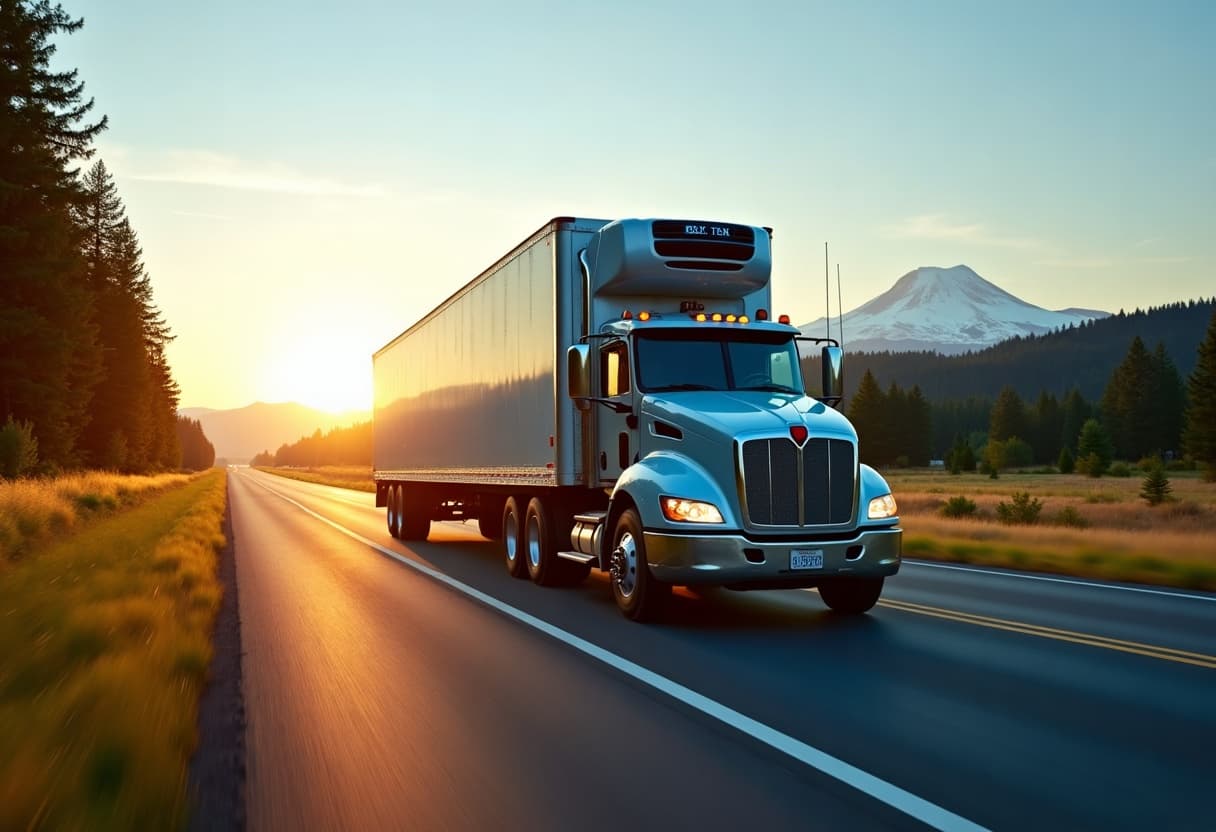
A reefer trailer rolls south on I-5 out of the Port of Tacoma, its compressor humming against the August heat. Inside, the air holds at 34°F. The pallets inside — fresh Washington produce bound for a distribution center in Portland — cannot afford a single degree of drift. One missed fuel stop, one long door-open at a dock, and the whole load is a loss. That is the reality of temperature-controlled freight.
Temperature-controlled freight carriers are the segment of trucking built for exactly this kind of cargo. If you ship anything perishable, frozen, or heat-sensitive, the reefer setting on the trailer is not a detail — it is the product. This guide explains what temperature-controlled freight is, how the cold chain stays intact, what can go wrong, and what to look for when you book a reefer move in the Pacific Northwest.
What is temperature-controlled freight?
Temperature-controlled freight is cargo that must be held within a defined temperature range from the moment it is loaded until the moment it is delivered. The equipment that does the work is most often a refrigerated trailer — a "reefer" — with a self-contained diesel compressor unit that chills, freezes, or heats the box as needed.
The range depends entirely on the product. Fresh produce often rides between 33°F and 40°F. Frozen foods hold at 0°F or below. Pharmaceuticals and biologics can demand tighter windows, sometimes ±2°F. Some chemical and industrial ingredients need to be kept warm above a minimum pour point in winter. The carrier does not pick the temperature — the shipper's product spec does — but the carrier is responsible for holding it.
This is different from standard inland freight transport, where a dry van is fine and the only risk is damage or delay. With temperature control, time and temperature together define whether the load arrives as product or as scrap.
What cargo needs temperature control?
The cold chain covers a wider list than most shippers first assume:
- Fresh and frozen food. Produce, seafood, meat, dairy, and frozen packaged goods. Washington apples, Oregon berries, and Pacific seafood all ride reefer out of the Puget Sound region.
- Pharmaceuticals and biologics. Vaccines, blood products, and many drugs degrade outside a narrow band. These moves often require documented temperature logs for compliance.
- Chemicals and industrial ingredients. Some resins, adhesives, and food additives must be kept within a range to remain usable.
- Electronics and specialty goods. Certain components and cosmetics are temperature-sensitive in transit.
If your product has a storage temperature on its spec sheet, it almost certainly needs temperature-controlled freight.
How the cold chain stays intact
The cold chain is a chain because it breaks at any weak link. A reefer carrier protects it across four stages:
Pre-cool. Before loading, the trailer is brought to the target temperature empty. Loading into a warm box means the cargo fights the trailer's thermal mass for the first hour — and often loses.
Fast loading. Doors stay closed as much as possible during loading and unloading. Every minute a reefer door is open, conditioned air escapes and outside heat and humidity enter. Good carriers stage loads to minimize door-open time.
Set and record. The reefer is set to the shipper-specified temperature and the setting is recorded on the bill of lading. Continuous temperature monitoring — either a reefer data logger or a telematics feed — creates the audit trail that proves the load held spec in transit.
Monitor in transit. The compressor runs on diesel, which means the unit needs fuel. A carrier that runs reefer freight watches fuel levels, alarms, and route timing. A skipped fuel stop or a stuck-in-traffic delay is not just late freight — it is spoiled freight.
When a load also moves through a port or rail ramp, the chain has to survive the handoff too. For containerized reefer cargo arriving at the Port of Seattle or Port of Tacoma, the drayage carrier has to hook the reefer to a powered chassis or genset quickly so the container never stops being refrigerated. That handoff is where many cold chain breaks happen.
What can go wrong
Most cold chain failures are operational, not equipment failures:
- Long door-open time. The single most common cause of out-of-spec loads. Drivers under pressure to load or unload fast sometimes leave doors open far longer than the reefer can recover from.
- Missed fuel stops. A reefer compressor burns diesel separately from the tractor. Run out of reefer fuel and the box warms in hours.
- Wrong set point. A reefer set to 40°F when the product needs 33°F will not fail loudly — it will silently hold the wrong temperature for the whole trip.
- No documentation. Without a temperature log, a receiver disputing a load has no proof either way. The shipper eats the claim.
The carriers that handle this well are the ones that treat the temperature reading as part of the shipment, not as background noise.
Choosing a temperature-controlled carrier in the PNW
In the Pacific Northwest, temperature-controlled freight moves on a few common lanes: produce and seafood out of Washington and Oregon, imports through the Port of Seattle and Port of Tacoma to inland distribution centers, and regional distribution from Kent and the Kent Valley to retail and foodservice customers across the region.
When you book a reefer move, ask the carrier four things:
- Is the equipment reefer-rated and pre-cooled before loading? If the answer is "we'll set it when we get there," keep looking.
- Is temperature monitored and logged for the whole trip? You want a record, not a promise.
- Does the carrier run its own equipment? An asset-based carrier with its own reefer fleet controls maintenance and fueling. A brokered reefer load adds a hand-off you cannot verify.
- Does the carrier know your lane? A carrier that already runs the Port of Tacoma to Portland produce lane knows the fuel stops, the timing, and the receivers.
All Season Transport runs an asset-based fleet of 60 company-owned trucks out of Kent, WA, with reefer-equipped units available for cold chain moves across Washington, Oregon, Montana, Idaho, and California. Because we own the trucks and the drayage equipment, we control the chain from the port ramp to the dock door — no brokered hand-offs, no unverified third-party reefer. That direct ownership is what makes a cold chain reliable.
The bottom line
Temperature-controlled freight is not just freight that happens to be cold. It is a shipment where the temperature is part of the product, and every link in the chain — pre-cool, loading, monitoring, fuel, handoff — has to hold. If you ship perishable or heat-sensitive cargo in the Pacific Northwest, the carrier you pick is the difference between product that arrives and product that arrives as intended.
Need a reefer move out of the Port of Seattle, Port of Tacoma, or a distribution center in the Kent Valley? Reach out to our dispatch team — we will set the temperature, watch the fuel, and keep the chain intact to the dock door.
FAQ
- What is a temperature-controlled freight carrier?
- A temperature-controlled freight carrier moves cargo in equipment that holds a specific temperature range, most often a refrigerated (reefer) trailer with an onboard compressor. The carrier monitors and document the reefer setting from pickup through delivery so perishable, frozen, or heat-sensitive freight stays within spec.
- What kinds of freight need temperature control?
- Common temperature-controlled cargo includes fresh produce, seafood, dairy and frozen foods, pharmaceuticals and biologics, chemicals, electronics, and some industrial ingredients. Any product whose quality or safety changes outside a defined temperature window needs reefer or heated service.
- How is the cold chain kept intact from port to delivery?
- The chain is maintained by pre-cooling the trailer, loading fast with doors closed, setting and recording the reefer temperature, monitoring fuel and alarms in transit, and unloading promptly at the destination. Breaks at any step — a long door-open, a missed fuel stop, or a failed compressor — break the chain and spoil the load.
- Does All Season Transport run temperature-controlled freight in Washington and Oregon?
- Yes. Our Kent, WA-based fleet of 60 company-owned trucks runs regional and long-haul lanes across Washington, Oregon, Montana, Idaho, and California, with reefer-equipped units available for cold chain moves originating at the Port of Seattle and Port of Tacoma.