
Liftgate Service 101: What It Is and When You Need It for Final-Mile Delivery
A shipping container clears customs at the Port of Tacoma. Your freight is on a truck headed for a warehouse in Kent. But the destination has no loading dock, just a street-level door. Without a way to lift the freight off the truck bed, the driver is stuck. That is where liftgate service comes in.
Liftgate service is one of those freight details that seems minor until the day you actually need it. If you ship anything heavy to a place without a dock, it stops being optional. This guide explains what liftgate service is, how it works, when to request it, and what to expect when booking a shipment that needs one in the Puget Sound area.
What is liftgate service?
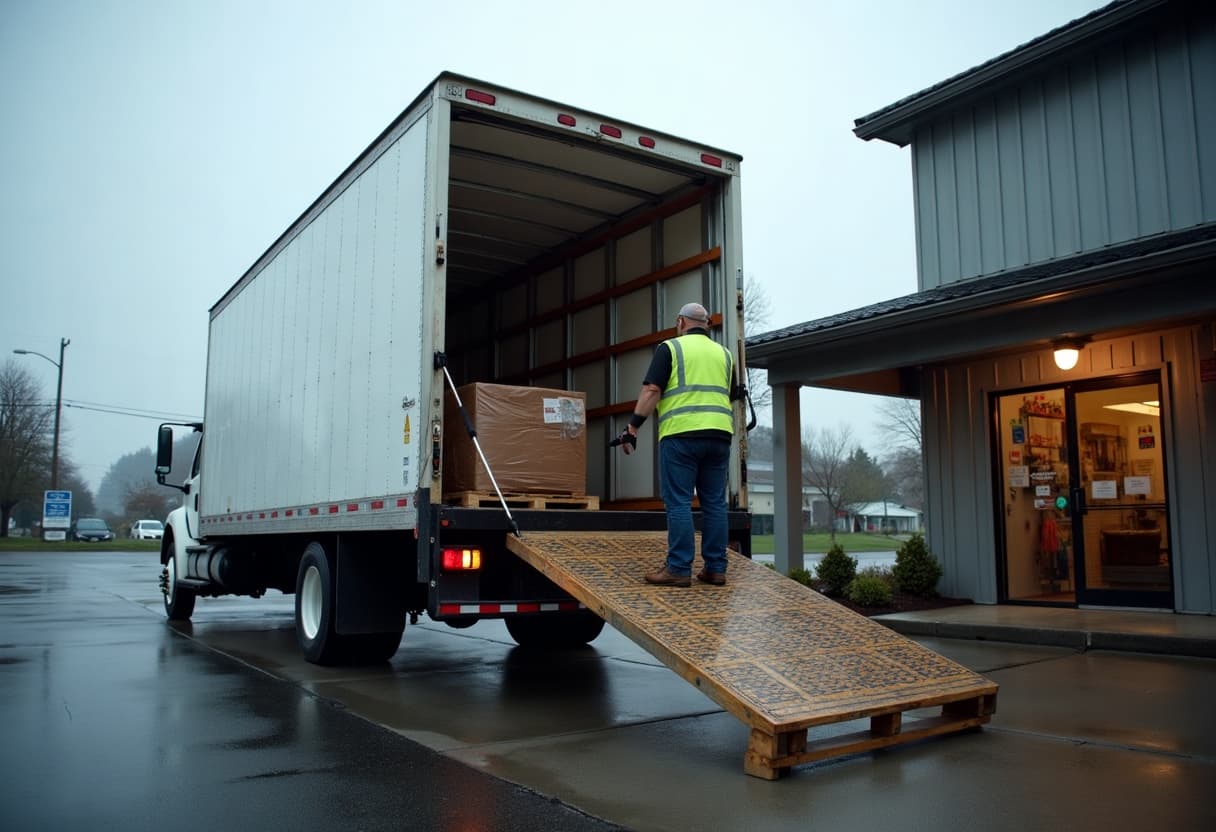
A liftgate is a flat metal platform attached to the back of a truck, powered by a hydraulic system. The driver uses it as an elevator to raise freight from street level to the truck bed, or lower it back down. When someone books ground shipping and freight services that include a liftgate, the truck arrives with that equipment already mounted.
The mechanics are simple. The platform folds up against the back of the truck during transit. At the pickup or delivery stop, the driver lowers the platform to street level, slides the freight onto it, and raises the platform to truck-bed height. The process reverses for unloading. No forklift, no dock, no loading ramp needed.
When do you need liftgate service?
The short answer: whenever the origin or destination lacks a loading dock and the freight cannot be safely lifted by hand. Here are the common situations:
Residential deliveries. Homes do not have loading docks. If you are receiving palletized building materials, large appliances, or commercial equipment at a residential address in the Seattle area, a liftgate is how it gets off the truck.
Commercial locations without docks. Strip malls, restaurants, retail storefronts, and small offices often have street-level access with no dock. A liftgate bridges that gap.
Construction sites. Delivering drywall, steel, or equipment to a job site means the ground is your dock. A liftgate handles the drop.
Pickups from locations without docks. It works both directions. If a shipper needs freight picked up from a warehouse floor that has no dock-level access, the driver uses the liftgate to load.
If you are shipping through Kent and the Tacoma port corridor, it is worth noting that many distribution centers along the SR 167 corridor in Kent, WA have docks, but the final destination often does not. Planning for that last segment is what separates a smooth delivery from a stuck truck.
How liftgate service works in practice
When you book a shipment requiring liftgate service, the dispatcher notes it on the rate confirmation and assigns a liftgate-equipped truck. On the day of delivery, the driver backs into the location, lowers the gate, and handles the freight from there.
For container drayage moves from the Port of Seattle or Tacoma, the container arrives at a distribution center where it is transloaded. From there, individual shipments fan out to final destinations, many of which need liftgate service for that last mile. All Season Transport, based at 22408 76th Ave S. in Kent, runs both legs, which means the drayage move and the liftgate delivery can be coordinated through one carrier rather than two.
A few practical details to know:
- Palletized freight works best. Loose boxes and irregularly shaped items can be harder to balance on the gate platform.
- Weight limits apply. Most liftgates on freight trucks handle up to 4,500 pounds. If your shipment exceeds that, ask about heavy-duty liftgate options or alternative equipment.
- Clearance matters. The truck needs room to back in and lower the gate. Tight alleys or angled parking can complicate the maneuver.
Liftgate service vs. other accessorial fees
Liftgate service is classified as an accessorial charge, meaning it is an add-on to the base freight rate. Other common accessorials include detention time, fuel surcharges, and inside delivery. The key is requesting it at booking rather than after the truck arrives.
When a driver arrives at a location without a dock and no liftgate was requested, two things happen: the delivery cannot be completed, and a re-delivery fee gets added to your invoice. Specifying liftgate service upfront avoids that scenario entirely.
Planning final-mile delivery in the Pacific Northwest
The geography of the Puget Sound region makes liftgate service particularly relevant. Containerized freight flows through the Port of Seattle and Port of Tacoma to distribution centers in Kent, Sumner, and Fife. From there, deliveries fan out to residential neighborhoods, commercial strips, and construction sites across King and Pierce counties.
Our fleet of 50-plus trucks at All Season Transport covers Washington, Oregon, Idaho, and Montana. For shippers moving freight through the Kent Valley, having one carrier handle the drayage leg from the port and the liftgate delivery at the destination removes a handoff that often causes delays and lost freight.
How to request liftgate service
When you book a shipment, tell the dispatcher the destination lacks a loading dock and you need a liftgate. Include the weight of the freight, the number of pallets or pieces, and any site access details, such as narrow streets or parking constraints. That information goes on the rate confirmation and routes to the driver assigned to the load.
If you are unsure whether your destination needs a liftgate, ask. The cost of adding one at booking is a fraction of the cost of a failed delivery and a re-delivery attempt.
Frequently asked questions about liftgate service
Is liftgate service the same as inside delivery? No. Liftgate service gets the freight from the truck bed to street level. Inside delivery means the driver carries the freight through the door and into the building. They are separate services and priced separately.
Can I request liftgate service for both pickup and delivery? Yes. If neither the origin nor the destination has a dock, specify liftgate service at both ends when booking.
How much does liftgate service cost? The fee varies by carrier and region but typically adds a flat accessorial charge to the base freight rate. Contact us for a quote that includes any required liftgate service.
If you are shipping freight in the Pacific Northwest and need liftgate delivery, reach out to All Season Transport or call (253) 893-8864. We handle drayage from the Port of Seattle and Port of Tacoma, ground shipping across the region, and final-mile liftgate delivery from our base in Kent, WA.
FAQ
- What is a liftgate on a truck?
- A liftgate is a hydraulic platform mounted on the back of a truck that raises and lowers freight between street level and the truck bed. It allows drivers to load and unload heavy or oversized items at locations without a loading dock.
- When do I need liftgate service?
- You need liftgate service when your pickup or delivery location has no loading dock and the freight is too heavy to be hand-loaded. Residential deliveries, strip mall storefronts, and construction sites commonly require a liftgate.
- How much weight can a liftgate handle?
- Most standard liftgates on freight trucks handle up to 3,000 to 4,500 pounds. Palletized freight, appliances, and building materials within that range can typically be moved with a liftgate.
- Does All Season Transport offer liftgate delivery in the Seattle and Tacoma area?
- Yes. Our fleet of 50-plus trucks operates throughout Washington, Oregon, Idaho, and Montana, with liftgate-equipped units available for final-mile deliveries from the Port of Seattle and Port of Tacoma to destinations across the Puget Sound region.