
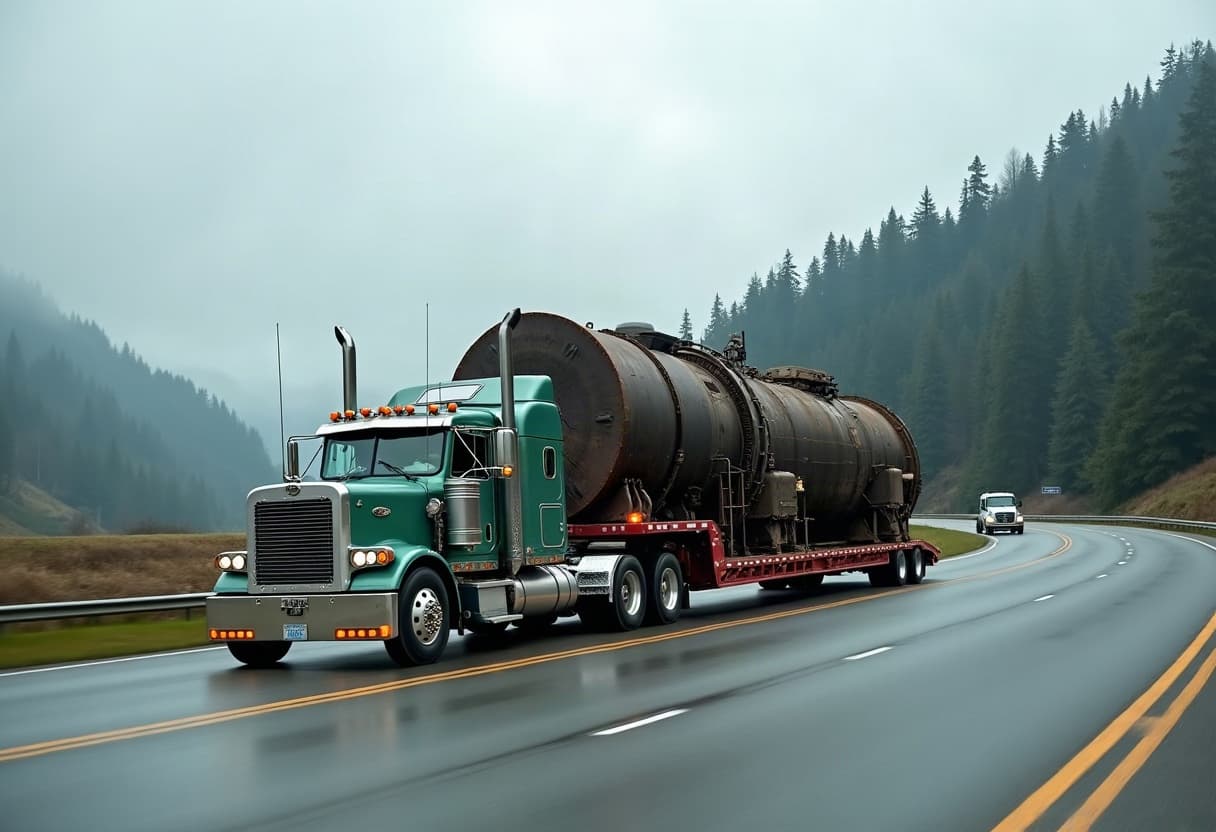
When a construction project in Seattle needs a 12-foot-wide transformer delivered from a rail siding in Kent, or a manufacturer in Auburn ships a 90,000-pound press to a facility in Portland, that freight does not fit in a dry van. It exceeds legal dimensions, requires permits, and demands a carrier with the right trailer and the right authority to move it. That is oversized load trucking — the movement of freight that sits outside the normal size and weight envelope of standard trucking.
All Season Transport runs specialized transport and flatbed hauling services from Kent, WA, for oversized and overweight freight across Washington, Oregon, Idaho, and the broader I-5 corridor. This page covers what qualifies as an oversized load, how permitting works in Washington, what equipment is required, what it costs, and how to book a heavy haul move.
What counts as an oversized load
Legal trucking dimensions are set by federal and state regulations. In Washington State, a load is considered oversize or overweight when it exceeds any of these limits:
- Width — over 8 feet 6 inches (102 inches).
- Height — over 13 feet 6 inches (162 inches).
- Length — over 53 feet for a single trailer, or over 75 feet overall for a tractor-trailer combination.
- Weight — over 20,000 pounds on a single axle, 34,000 pounds on a tandem axle, or 80,000 pounds gross vehicle weight without a permit.
Anything beyond those thresholds needs a permit to move legally. Some loads exceed only one dimension — a 10-foot-wide precast concrete panel is oversize in width but not in height or weight. Others exceed multiple: a 12-foot-wide, 120,000-pound transformer is both oversize and overweight, requiring a multi-axle trailer, a route survey, and front and rear escort vehicles.
Oversize permits in Washington State
The Washington State Department of Transportation (WSDOT) issues oversize and overweight permits for loads exceeding legal limits. The permit specifies the approved route, travel times, and any escort or signage requirements. Key rules in Washington:
- Travel restrictions — oversize loads typically cannot move at night, on weekends, or during holiday periods. Some routes have daytime-only restrictions.
- Escort requirements — loads over 10 feet wide on two-lane roads or 12 feet wide on interstates require front and rear pilot vehicles. Loads over 14 feet may need additional escorts and utility coordination.
- Route surveys — the carrier must file an approved route that avoids low bridges, weight-restricted structures, and construction zones. A 14-foot-tall load cannot take every interstate exit — the route has to be pre-cleared.
- Bridge weight limits — overweight loads may need bridge analysis and time-of-day restrictions to avoid crossing during heavy traffic.
Moving across state lines means filing permits in each state. A load from Kent, WA to Portland, OR needs Washington and Oregon permits, with matching route approvals at the border. All Season Transport coordinates the full permit package — Washington, Oregon, Idaho, and beyond — along with escort coordination and route surveys.
Equipment for oversized load trucking
The trailer has to match the load. Standard flatbeds handle freight up to legal dimensions, but oversized freight needs specialized equipment:
- Step-deck (drop-deck) trailers — a two-level deck that lowers the rear platform to give extra vertical clearance for taller loads. Used for freight between 9 and 11 feet tall.
- RGN (Removable Gooseneck) trailers — a low-boy design where the front detaches so equipment can be driven directly onto the deck. Used for heavy machinery, excavators, and loads that need self-loading.
- Multi-axle heavy-haul trailers — trailers with 9 to 20+ axles that distribute weight to stay within per-axle bridge limits. Used for loads over 80,000 pounds.
- Extended flatbeds and step-decks — stretched decks for long freight like wind turbine blades, structural steel, and prefabricated bridge sections.
Selecting the wrong trailer means a rejected delivery, a permit refile, or a reload. Our flatbed and specialized trucking service covers the full range of open-deck and heavy-haul equipment based at our Kent terminal.
Local knowledge: Kent, WA and the I-5 corridor
Kent sits 12 miles south of the Port of Seattle and 15 miles north of the Port of Tacoma, with direct access to I-5 north-south and SR-167 east-west. From Kent, an oversized load can reach:
- Port of Seattle and Port of Tacoma marine terminals for inbound project cargo, transformers, and heavy machinery discharged from ships.
- I-5 south to Portland and I-5 north to Bellingham for regional oversize moves through Oregon and into British Columbia.
- I-90 east through Snoqualmie Pass for construction and equipment freight heading into Central and Eastern Washington.
Snoqualmie Pass is a specific consideration for oversized loads — the pass has vertical clearance restrictions, winter chain requirements, and seasonal weight limits that affect routing. A heavy haul from Kent to Spokane may need a different trailer configuration or a detour via I-82 through the Yakima Valley depending on the season and load height. Local carriers who run these routes regularly know which exits clear a 14-foot load and which do not.
For a broader look at freight services based in the Kent Valley, our transport services in Kent, WA guide covers drayage, intermodal, and regional hauling from the same terminal.
What oversized load trucking costs
Heavy haul pricing is driven by load dimensions, weight, distance, permits, and escorts. In the Kent and Seattle market:
- Local heavy haul (under 100 miles) — typically $500 to $1,200 depending on trailer type, load complexity, and permit requirements.
- Regional oversize (100-500 miles) — $4 to $8 per loaded mile, plus permit fees ($50-$300 per state) and escort costs ($150-$250 per escort vehicle per day).
- Superload (over 200,000 pounds or extreme dimensions) — custom pricing based on route survey, utility coordination, police escort requirements, and multi-trailer configurations.
The most accurate quote comes from providing load dimensions (length, width, height, weight), pickup and delivery points, and any time constraints. We can usually turn around a heavy haul quote the same business day.
Choosing an oversized load carrier
Not every trucking company can move an oversized load. Before booking a heavy haul, verify:
- Motor carrier authority and insurance — active MC authority and cargo insurance adequate for the value of the load. Ask for the certificate of insurance.
- Permit and escort capability — the carrier should arrange WSDOT permitting, route surveys, and pilot car coordination in-house, not pass it to a third party.
- Equipment inventory — step-decks, RGNs, and multi-axle trailers on hand to match the load. A carrier who has to rent equipment adds cost and lead time.
- Regional experience — a carrier based in the Kent Valley knows the Puget Sound terminals, the Snoqualmie Pass restrictions, and the I-5 corridor routes that oversize loads can and cannot take.
All Season Transport is an asset-based carrier with 60 company-owned trucks, 200 private chassis, and a dispatch team that coordinates permits, escorts, and equipment from our Kent terminal. We own the trailers and employ the drivers — no broker handoff, no equipment uncertainty.
For smaller oversize loads under 10,000 pounds that need expedited delivery, our hotshot trucking services handle time-sensitive over-dimensional freight without the cost of a full heavy-haul rig.
Frequently asked questions
What is oversized load trucking?
Oversized load trucking is the transport of freight that exceeds legal width, height, length, or weight limits set by state and federal regulators. Loads wider than 8 feet 6 inches, taller than 13 feet 6 inches, or heavier than per-axle weight limits require oversize or overweight permits, specialized trailers, and often escort vehicles to move legally on public roads.
What permits are needed for an oversized load in Washington State?
Loads exceeding 8 feet 6 inches wide, 13 feet 6 inches tall, or 40,000 pounds per axle require oversize or overweight permits from the Washington State Department of Transportation. Additional permits may be needed for interstate moves through Oregon and Idaho. All Season Transport coordinates permitting, route surveys, and escort vehicles for oversized loads throughout the Pacific Northwest.
How much does oversized load trucking cost in the Pacific Northwest?
Oversized load trucking rates depend on distance, load dimensions, weight, permit fees, escort requirements, and trailer type. Local heavy haul moves under 100 miles in the Kent and Seattle market typically start around $500 to $1,200, while regional oversize hauls run $4 to $8 per loaded mile plus permit and escort costs. Request a quote with load dimensions and pickup and delivery points for an accurate rate.
Does All Season Transport offer specialized transport for oversized loads in Washington?
Yes. All Season Transport provides specialized transport and flatbed hauling services from our Kent, WA terminal, including oversized and overweight freight. Our fleet includes flatbed, step-deck, and specialized trailers for oversize and overweight freight, and we coordinate permits, escorts, and route surveys for moves across Washington, Oregon, Idaho, and beyond.
When freight exceeds legal dimensions, it needs a carrier with the right permits and equipment to move it safely. Call (253) 893-8864 or request a heavy haul quote with your load dimensions, weight, pickup, and delivery points, and we will get a rate back the same business day.
FAQ
- What is oversized load trucking?
- Oversized load trucking is the transport of freight that exceeds legal width, height, length, or weight limits set by state and federal regulators. Loads wider than 8 feet 6 inches, taller than 13 feet 6 inches, or heavier than per-axle weight limits require oversize or overweight permits, specialized trailers, and often escort vehicles to move legally on public roads.
- What permits are needed for an oversized load in Washington State?
- Loads exceeding 8 feet 6 inches wide, 13 feet 6 inches tall, or 40,000 pounds per axle require oversize or overweight permits from the Washington State Department of Transportation. Additional permits may be needed for interstate moves through Oregon and Idaho. All Season Transport coordinates permitting, route surveys, and escort vehicles for oversized loads throughout the Pacific Northwest.
- How much does oversized load trucking cost in the Pacific Northwest?
- Oversized load trucking rates depend on distance, load dimensions, weight, permit fees, escort requirements, and trailer type. Local heavy haul moves under 100 miles in the Kent and Seattle market typically start around $500 to $1,200, while regional oversize hauls run $4 to $8 per loaded mile plus permit and escort costs. Request a quote with load dimensions and pickup and delivery points for an accurate rate.
- Does All Season Transport offer specialized transport for oversized loads in Washington?
- Yes. All Season Transport provides specialized transport and flatbed hauling services from our Kent, WA terminal, including oversized and overweight freight. Our fleet includes flatbed, step-deck, and specialized trailers for oversize and overweight freight, and we coordinate permits, escorts, and route surveys for moves across Washington, Oregon, Idaho, and beyond.