
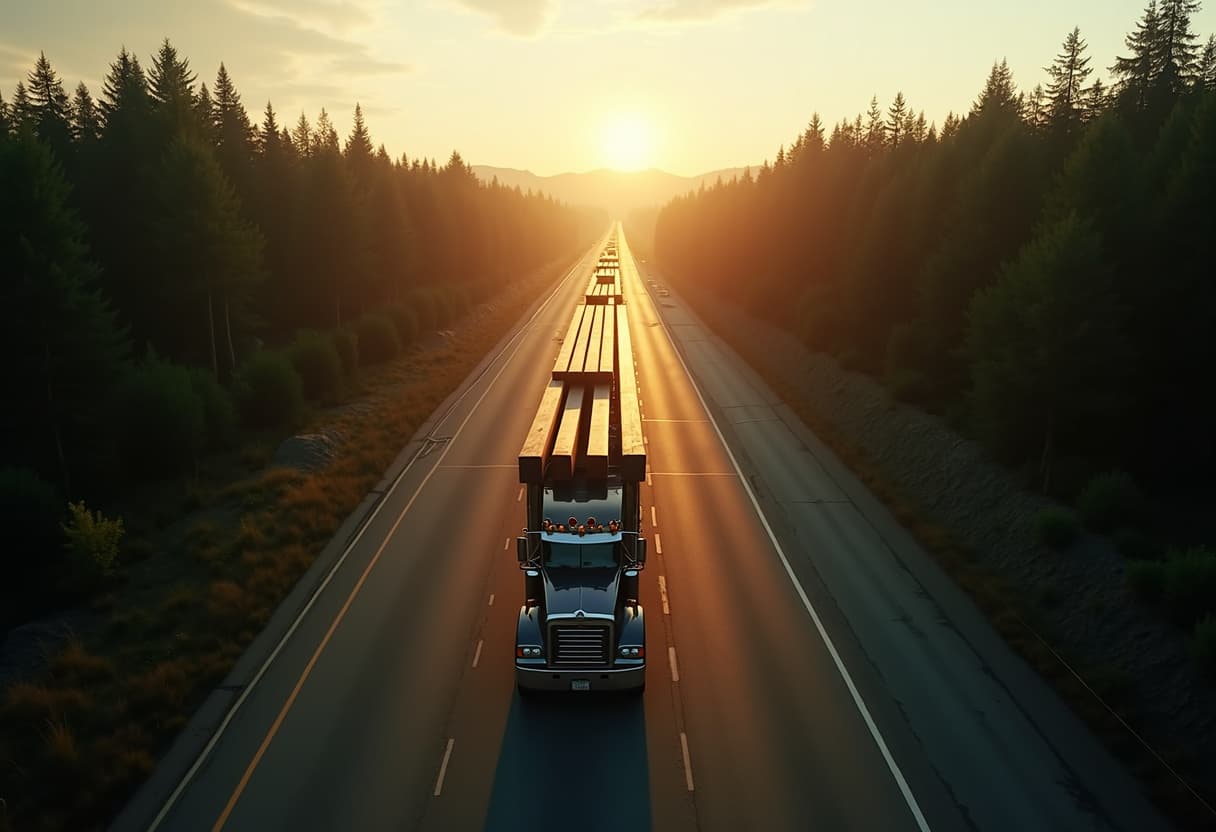
Flatbed & Specialized Trucking in the Pacific Northwest
Not everything moves in a 40-foot container. Steel beams for a bridge project, a prefabricated building module, an excavator heading to a site in Auburn, or a load of lumber leaving a mill in the Cascade foothills — all of it rides on a flatbed. In the Pacific Northwest, where construction, timber, and heavy industry run alongside one of the busiest port complexes on the West Coast, flatbed and specialized trucking is the service that keeps non-containerized freight moving.
All Season Transport operates flatbed and specialized trucking services out of Kent, WA, hauling oversize, overweight, and open-deck freight across Washington, Oregon, and the broader I-5 corridor. This guide explains how flatbed trucking works, what it costs, and when you need specialized trucking instead of a standard flat or step-deck.
What flatbed trucking covers
A flatbed trailer is an open deck with no walls and no roof. The freight sits on the deck and is secured with chains, binders, straps, and tarps. Because there is no enclosure, flatbed handles cargo that a dry van or container cannot:
- Oversize loads — freight wider than 8 feet 6 inches or taller than 13 feet 6 inches that exceeds legal enclosed-trailer dimensions.
- Overweight loads — heavy equipment, machinery, and steel that exceed van payload limits.
- Side-loaded or top-loaded freight — lumber, steel plate, pipe, and precast concrete that need a crane, forklift, or side-loader rather than a dock.
- Irregularly shaped cargo — prefabricated structures, tanks, and manufactured goods that do not fit standard trailer geometry.
Flatbed is the workhorse of construction, manufacturing, and heavy industry. If your freight needs open-air loading or is too big for a box, it needs a flatbed.
Flatbed trailer types used in the Pacific Northwest
Not all flatbeds are the same. Carriers in the Kent and Seattle market deploy several deck types depending on the load:
- Standard flatbed — 48 or 53 feet long, 102 inches wide, loadable from the sides and top. The most common open-deck trailer for general freight, steel, lumber, and building materials.
- Step-deck (drop-deck) — a two-level deck where the rear sits lower to give extra vertical clearance. Used for taller loads that would exceed height limits on a standard flatbed.
- RGN (Removable Gooseneck) — a low-boy trailer where the front detaches so equipment can be driven onto the deck. Used for heavy machinery, excavators, and loads that need to be loaded under their own power.
- Double-drop — an even lower deck for the tallest oversize loads, giving maximum height clearance within legal limits.
- Conestoga — a flatbed with a retractable tarp-on-frame enclosure. Gives the protection of a van trailer with the loading flexibility of a flatbed.
Choosing the right trailer is the first decision in any flatbed move. A load that fits a standard flatbed at 8 feet tall may need a step-deck at 11 feet, and getting it wrong means a permit, a reload, or a rejected delivery.
Specialized trucking: when flatbed is not enough
Specialized trucking is the tier above standard flatbed. It handles loads that exceed legal dimensions and require:
- Oversize and overweight permits — issued by the Washington State Department of Transportation for any load exceeding 8 feet 6 inches wide, 13 feet 6 inches tall, or 40,000 pounds per axle.
- Escort vehicles — pilot cars front and rear for loads over 10 feet wide on two-lane roads or 12 feet on interstates, required by Washington and Oregon state law.
- Route surveys — pre-cleared routes that avoid low bridges, weight-restricted roads, and construction zones. A 14-foot-tall load cannot take every interstate exit.
- Multi-axle trailers — additional trailer axles to distribute weight and stay within per-axle limits on bridges and pavement.
- Time-of-day restrictions — oversize loads in Washington typically cannot travel at night, on weekends, or during holiday periods.
All Season Transport coordinates the entire specialized package — permits, escorts, route surveys, and the right trailer configuration — so the load moves legally and on schedule.
What flatbed and specialized trucking costs in the Pacific Northwest
Flatbed pricing is driven by distance, load weight, equipment type, tarping, and permit requirements. In the Kent and Seattle market:
- Local flatbed move (under 100 miles) — typically $350 to $800 depending on load complexity and wait time.
- Regional flatbed (100 to 500 miles) — $3 to $5 per loaded mile, with a minimum charge for short hauls.
- Specialized oversize or overweight — higher base rates plus permit fees, escort costs, and potential surcharges for night or weekend movement where allowed.
- Tarping — typically $50 to $150 additional when the load needs protection from weather or road debris.
The most accurate pricing comes from providing load dimensions (length, width, height, and weight), pickup and delivery zip codes, and any time constraints when requesting a quote.
Why a Kent, WA flatbed carrier serves the Pacific Northwest well
Kent sits in the heart of the Kent Valley, the logistics corridor between the Port of Seattle and the Port of Tacoma. From Kent, a flatbed carrier can reach:
- Seattle and Tacoma marine terminals for inbound steel, machinery, and project cargo discharged from ships.
- I-5 north and south for regional moves into Oregon, British Columbia, and California.
- I-90 and US-2 east for construction and timber loads heading into the Cascades and eastern Washington.
- Kent, Auburn, Renton, and Fife industrial parks for local construction, manufacturing, and heavy-equipment delivery.
Having a flatbed carrier based in Kent means shorter deadhead miles, faster response for last-minute construction and project freight, and a driver who knows the routes, the terminals, and the permitting landscape in Washington. For anyone weighing whether to build that capacity themselves, our guide to the cost of starting a trucking company breaks down the truck, insurance, and permit expenses involved.
Choosing a flatbed trucking company
When you need a flatbed or specialized carrier, look for:
- The right equipment — standard flatbed, step-deck, RGN, or double-drop matching your load dimensions.
- Permit and escort capability — in-house coordination of Washington and Oregon oversize permits, route surveys, and pilot cars.
- Experience with your freight type — steel, lumber, machinery, construction materials, and oversize manufactured goods all load and secure differently.
- Local knowledge — a carrier who knows the Puget Sound terminals, the Kent Valley industrial parks, and the I-5 corridor moves your freight faster and avoids the permits and routes that cause delays.
- Insurance and authority — active motor carrier authority and cargo insurance adequate for the value of your load.
All Season Transport runs flatbed and specialized trucking from Kent, WA, with the equipment, permitting, and local route knowledge to move oversize and open-deck freight across the Pacific Northwest. If your load will not fit in a container or a van, request a flatbed quote with your load dimensions and pickup and delivery points, or browse our full range of transport services from the Kent Valley.
New to hauling freight through the Puget Sound? See our guide to transport services in Kent, WA for an overview of drayage, intermodal, and regional hauling from the Kent Valley, or learn how container drayage connects the Port of Seattle and Port of Tacoma to inland receivers. For loads that need street-level delivery without a loading dock, our liftgate service handles the final drop. For smaller, time-sensitive loads under 10,000 pounds, our hotshot trucking services deliver expedited freight without waiting for a full trailer.
FAQ
- What is flatbed trucking?
- Flatbed trucking is the transport of freight on an open, flat-deck trailer with no walls or roof. The cargo is secured with chains, straps, and tarps rather than enclosed in a container or van trailer. Flatbed is used for oversize, overweight, irregularly shaped, or non-containerized freight such as steel, lumber, heavy machinery, and building materials that will not fit inside a standard dry van.
- How much do flatbed trucking services cost in the Pacific Northwest?
- Flatbed rates in Washington and the Pacific Northwest depend on distance, load weight, equipment type, permit requirements, and tarping. A local flatbed move under 100 miles in the Kent and Seattle market typically ranges from $350 to $800. Longer regional hauls and oversize or overweight loads requiring permits run higher. Request a quote with load dimensions and pickup and delivery zip codes for an accurate rate.
- What is the difference between flatbed and specialized trucking?
- Flatbed trucking covers standard open-deck freight on a flat or step-deck trailer. Specialized trucking is a subset of flatbed that handles oversize, overweight, or high-value loads requiring additional permits, escort vehicles, multi-axle trailers, or specific rigging. All specialized trucking is flatbed, but not all flatbed is specialized.
- Do I need permits for an oversize or overweight load in Washington?
- Yes. Loads exceeding Washington State legal dimensions (8 feet 6 inches wide, 13 feet 6 inches tall, 40,000 pounds per axle) require oversize or overweight permits from the Washington State Department of Transportation. All Season Transport coordinates permitting, route surveys, and escort vehicles for specialized moves throughout the Pacific Northwest.
- What types of freight require a flatbed truck?
- Flatbed trucks handle freight that cannot go in a closed van or container: steel coils and plate, lumber and engineered wood, precast concrete, heavy equipment and machinery, construction materials, pipe and rebar, wind energy components, and oversize manufactured goods. If the cargo is too wide, too tall, too heavy, or needs to be loaded from the side or top, it needs a flatbed.