
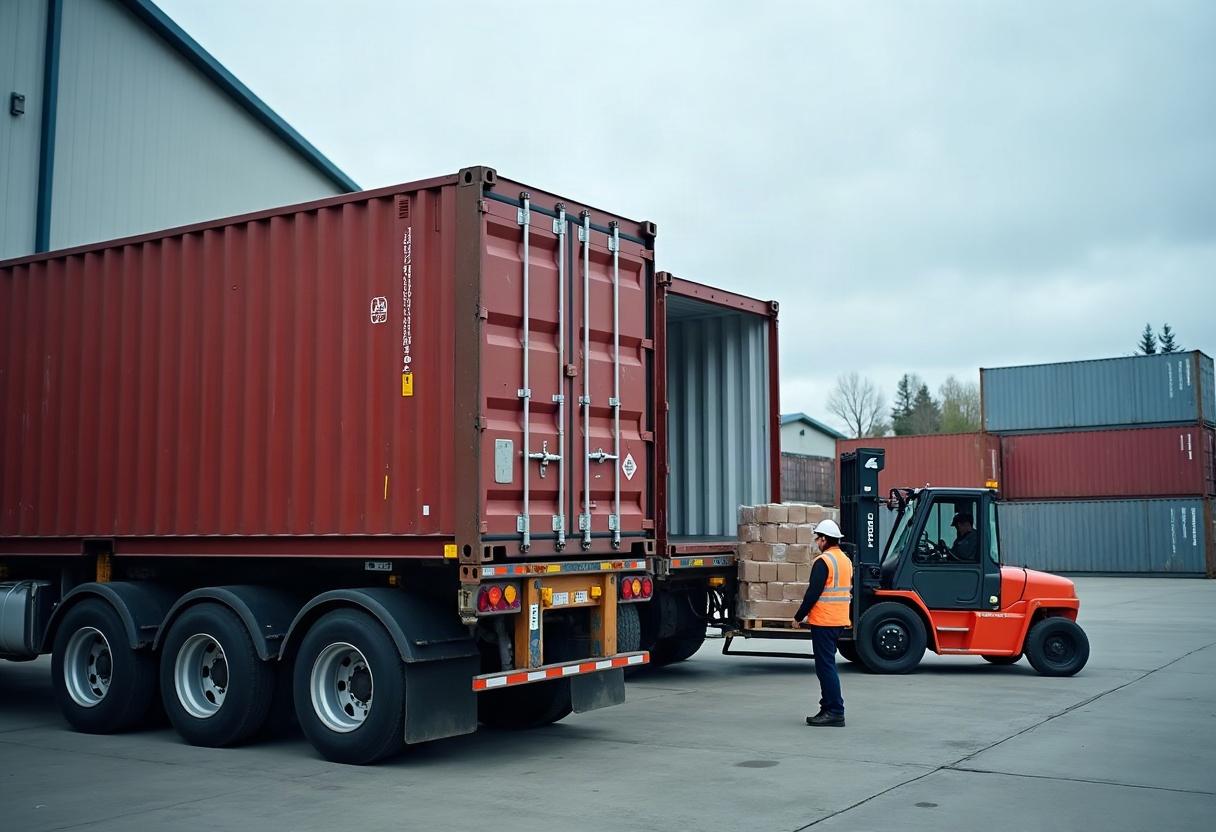
A 40-foot container clears customs at the Port of Tacoma on a Tuesday afternoon. It needs to be at a warehouse in the Kent Valley by Wednesday morning, positioned at a dock so a forklift can strip the pallets, and the empty needs to be back at the terminal within 48 hours to avoid demurrage. That sequence — terminal pickup, drayage to the receiver, positioning for unload, and empty return — is what a container unloading service actually does. It is a trucking move, not a warehouse operation, and in the Kent, WA market it runs on a tight clock.
If you are searching for container unloading in Kent, you are most likely an importer, freight forwarder, or distribution manager who has a container coming off the Port of Seattle or Port of Tacoma and needs a carrier that can deliver it to your dock, stage it for unload, and recover the empty on schedule. This guide covers what the container unloading service includes, how live unload differs from drop delivery, and why a Kent-based asset carrier keeps the leg on time.
What container unloading service covers
Container unloading service is the drayage-side portion of getting a shipping container from the terminal to the receiver's dock and getting the cargo out of the box. The carrier is responsible for the truck, the chassis, the driver, terminal coordination, and delivery; the receiving facility is responsible for physically stripping the cargo out of the container. The carrier's job ends when the container is positioned for unload and, in the case of a live move, when the empty is pulled away.
In Kent, a typical container unloading move includes:
- Terminal pickup. A TWIC-cardholding driver arrives at the Port of Seattle or Port of Tacoma terminal with a booking number, picks up a grounded container, and stages it on a company-owned chassis for the dray to Kent.
- Drayage to the receiver. The container moves from the terminal to a warehouse, distribution center, or yard in the Kent Valley — usually a 12 to 25 mile run, almost all of it on I-5 and SR 167.
- Positioning for unload. The container is spotted at a dock door for live unload, or dropped in a yard for the receiver to strip on their own schedule.
- Empty recovery. Once the cargo is out, the carrier returns the empty container and chassis to the terminal or depot within the steamship line's free-time window.
What makes this a service rather than a one-off truck move is the scheduling around the unload itself. A carrier that only drops a box and disappears leaves the shipper to manage dwell time, demurrage, and chassis days. A carrier that runs container unloading as a service manages those clocks.
Live unload vs. drop container delivery
The single biggest decision in a container unloading move is whether the receiver runs a live unload or takes a drop. Each has a different cost structure and a different operational footprint.
Live unload means the driver stays with the container at the dock while the receiver strips it. The clock starts when the container is grounded at the door and the driver typically has two to four hours to turn the box, depending on the carrier's free-time allowance. Live unload is the right call when the receiver has a fast-moving dock crew, a forklift staged, and enough door capacity to dedicate a bay for the duration. It avoids chassis-day charges and keeps the carrier's equipment moving.
Drop delivery means the carrier spots the loaded container in a yard or at a dock and leaves the chassis under the box. The receiver unloads on their own schedule — sometimes the same day, sometimes over a 24 to 48 hour window — and the carrier returns to pull the empty. Drops are used when dock congestion prevents a quick live turn, when the cargo is slow to strip, or when the receiver wants to stage multiple containers at once. The trade is convenience against chassis-day and demurrage exposure.
In Kent, where warehouse space is dense and dock doors are at a premium in peak season from August through October, the right choice often shifts week to week. A carrier that runs both options on a company-owned chassis fleet can flex between the two without renegotiating the move.
Why a Kent, WA base keeps container unloading on time
Location is the variable that decides whether a container unloading move makes its window. All Season Transport is headquartered at 22408 76th Ave S, Suite 200, Kent, WA 98032, sitting at the intersection of I-5 and SR 167 in the middle of the Kent Valley logistics corridor. The yard is roughly 12 miles from the Port of Tacoma and 15 miles from the Port of Seattle, and millions of square feet of warehouse and distribution space sit within minutes of the dispatch point.
That geometry produces three working advantages for shippers running container unloading in Kent:
- Short deadhead to the terminal. A driver leaving the Kent yard can be at a Tacoma terminal gate in under 30 minutes and a Seattle terminal in under 45, which means faster container pickup once a release comes through.
- Short delivery miles. The dray from the terminal to most Kent receivers is 12 to 25 miles on interstate, with no urban congestion to clear. A container picked up at 8 AM can be on a Kent dock by 10.
- Close empty return. When a live unload finishes, the empty can be back at the terminal or depot the same afternoon, which keeps the shipper inside the steamship line's free-time window and out of demurrage.
For a deeper look at the Kent Valley as a logistics hub, see transport services in Kent, WA.
How All Season Transport runs container unloading in Kent
All Season Transport is an asset-based, customs-bonded carrier with 60 company-owned trucks and 200 private chassis. The fleet runs drayage from the Port of Seattle and Port of Tacoma into the Kent Valley and across the broader Pacific Northwest from the Kent dispatch point, with port and rail drayage as the core service line.
Because the chassis are company-owned, every container unloading move has guaranteed equipment. There is no brokered chassis scramble during peak season, no third-party hand-off between the drayage driver and the recovery driver, and no day-rate chassis rental baked into the quote. When a container is ready at the terminal, the truck and chassis are ready at the yard.
The fleet also covers the adjacent services that container unloading shippers in Kent usually need in the same move. Transloading solutions handle the physical strip of the cargo out of the container and the repack into a different trailer or set of pallets. Inland freight transport handles the line-haul of that repacked freight onward to a distribution center in Sumner, a retail location in Spokane, or a regional destination across Washington, Oregon, Montana, Idaho, and California. Running these under one carrier eliminates the handoff between a drayage provider and a line-haul carrier, which is where container unloading moves most often stall.
For context on how container drayage works at the Seattle and Tacoma terminals, see the container drayage guide. For the broader move of containers between rail, port, and warehouse, see terminal transfer in Kent, WA.
Who uses container unloading service in Kent
Container unloading service in Kent serves any shipper whose imported cargo comes through the Port of Seattle or Port of Tacoma and needs to be stripped at a local facility. In the Pacific Northwest that includes:
- Importers and freight forwarders running 40-foot and 40-foot high-cube containers into Kent distribution centers and needing the empty returned within free time.
- Warehouse operators in the Kent Valley that receive containers at their docks and need a carrier that can flex between live unload and drop as their door capacity shifts.
- Manufacturers and distributors that stage inbound containers in a yard and strip them on a rolling schedule rather than at a single dock.
- Transload operations that pull cargo out of an import container and repack it into domestic equipment for line-haul across the region.
For each of these, the value of an asset-based Kent carrier is the same: the truck, the chassis, and the driver are all under one roof, the schedule is controlled by one dispatcher, and the empty return is on the same carrier's clock as the original delivery.
Booking container unloading in Kent
If you have a container coming off the Port of Seattle or Port of Tacoma and need it delivered and positioned for unload at a facility in the Kent Valley, contact the dispatch team at (253) 893-8864 or info@allseasontransport.com, or request a quote through the contact page. Operations run 24/7, so a container unloading move can be booked the same day the release comes through the terminal.
FAQ
What is container unloading service in Kent, WA? Container unloading service in Kent, WA is the drayage and delivery leg that moves a shipping container from the Port of Seattle or Port of Tacoma to a Kent area warehouse or yard, then positions it for live unload or drop trailer so the receiving facility can strip the cargo. The carrier supplies the truck, chassis, driver, and terminal coordination.
What is the difference between live unload and drop container delivery? Live unload means the driver waits at the dock while the container is unloaded, usually within two to four hours, and leaves with the same chassis. A drop means the carrier spots the loaded container and returns later — typically within 24 to 48 hours — to pick up the empty. Drops are used when the receiver needs more time to strip the box or when dock congestion prevents a quick live turn.
Why does a Kent, WA base keep container unloading on schedule? All Season Transport is headquartered at 22408 76th Ave S, Suite 200, Kent, WA 98032, roughly 12 miles from the Port of Tacoma and 15 miles from the Port of Seattle, at the intersection of I-5 and SR 167. Short deadhead miles from yard to terminal mean faster container pickup, and short delivery miles to Kent warehouses mean tighter unloading windows.
How do I book container unloading service with All Season Transport? Contact the dispatch desk at (253) 893-8864 or info@allseasontransport.com. Operations run 24/7, so a container unloading move can be booked the same day the release comes through. Because the fleet is company-owned, capacity is confirmed at booking rather than brokered to a third party.
FAQ
- What is container unloading service in Kent, WA?
- Container unloading service in Kent, WA is the drayage and delivery leg that moves a shipping container from the Port of Seattle or Port of Tacoma to a Kent area warehouse or yard, then positions it for live unload or drop trailer so the receiving facility can strip the cargo. The carrier supplies the truck, chassis, driver, and terminal coordination; the receiving facility supplies the dock crew, forklift, or transload equipment.
- What is the difference between live unload and drop container delivery?
- Live unload means the driver waits at the dock while the container is unloaded and then leaves with the same chassis, usually within two to four hours. A drop means the carrier spots the loaded container in a yard or at a dock and returns later — typically within 24 to 48 hours — to pick up the empty. Drops are used when the receiver needs more time to strip the box or when dock congestion prevents a quick live turn.
- How does a Kent, WA base keep container unloading on schedule?
- All Season Transport is headquartered at 22408 76th Ave S, Suite 200, Kent, WA 98032, roughly 12 miles from the Port of Tacoma and 15 miles from the Port of Seattle, at the intersection of I-5 and SR 167 in the Kent Valley logistics corridor. Short deadhead miles from yard to terminal mean faster container pickup, and short delivery miles from terminal to Kent warehouses mean tighter unloading windows and lower per-load cost.
- How do I book container unloading service with All Season Transport?
- Contact the dispatch desk at (253) 893-8864 or info@allseasontransport.com. Operations run 24/7, so a container unloading move can be booked the same day the release comes through. Because the fleet is company-owned, capacity is confirmed at booking rather than brokered to a third party.