
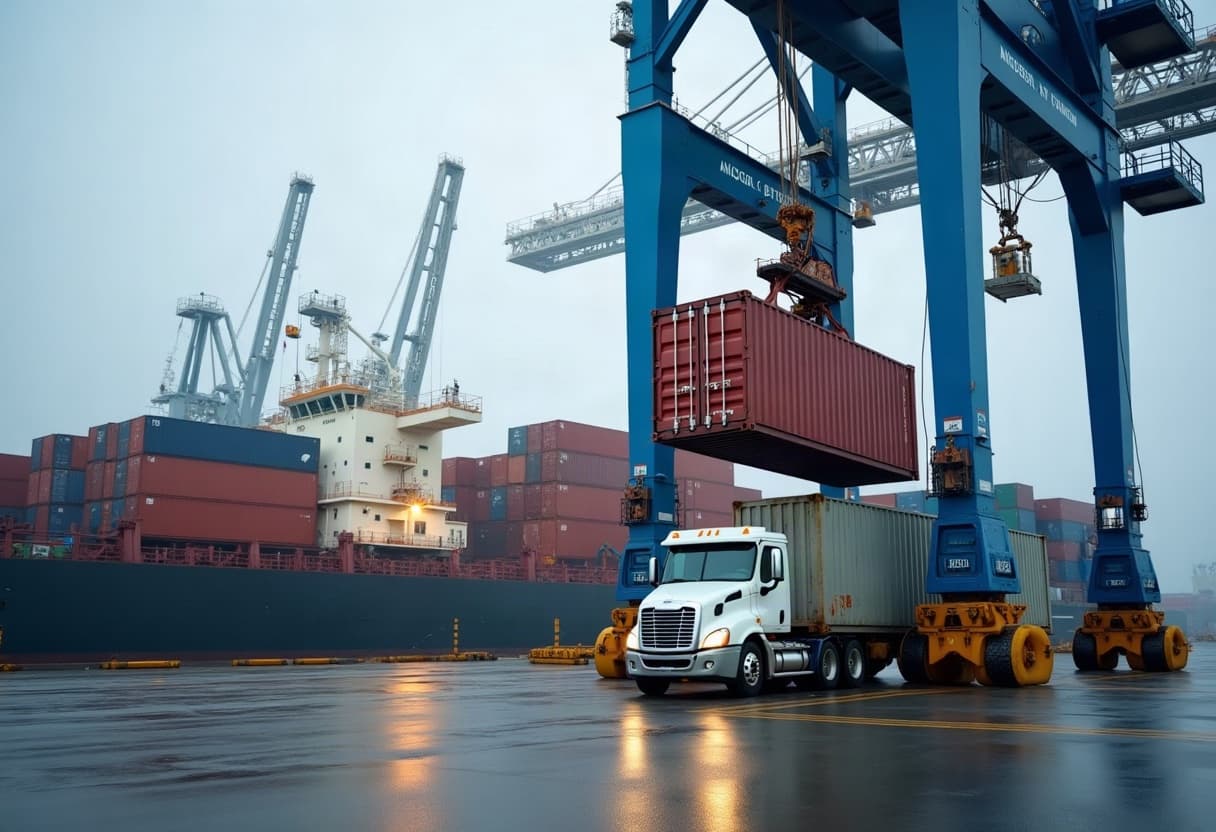
Intermodal logistics is how most of the goods sitting on store shelves in the Pacific Northwest actually got there. A container loaded in Shanghai, discharged at the Port of Seattle, railed to a distribution center, and trucked the final miles to a warehouse in Kent, WA traveled on three modes — but the cargo inside the container was never unpacked until the very end. That single idea, moving one sealed container across ship, rail, and truck without re-handling the freight, is the entire foundation of intermodal logistics.
This guide explains what intermodal logistics is, how it works at the Pacific Northwest's two major ports, where it saves money, and where a regional carrier fits into the chain.
What Intermodal Logistics Means
The Intermodal Association of North America defines intermodal logistics as the movement of containerized freight using more than one mode of transportation, with the container itself serving as the load unit that stays sealed across each transfer. The word "intermodal" literally means "between modes."
The key constraint is the container. Because the cargo stays inside the same steel box from origin to destination, a shipping line, a railroad, and a trucking company can each handle their portion of the trip without opening, sorting, or repacking the freight. A gantry crane lifts the container off a vessel and sets it on a chassis. A truck pulls it to a rail terminal. A well car carries it 1,000 miles. Another truck delivers it the last 25 miles. The container, not the cargo, is what moves between modes.
How Intermodal Shipping Works in the Pacific Northwest
The Pacific Northwest is a major intermodal gateway because two deep-water ports — the Port of Seattle and the Port of Tacoma — sit roughly 15 miles from a Kent Valley logistics corridor packed with distribution centers, cross-dock facilities, and rail intermodal yards. A typical import move looks like this:
- Vessel discharge. A container ship calls at Terminal 46 in Seattle or a Tacoma terminal. Gantry cranes lift containers off the vessel and stage them in the yard.
- Drayage to rail or warehouse. A drayage truck picks up the container on a chassis and moves it a short distance — often under 50 miles — to a rail ramp or a nearby distribution center. This is the drayage leg, and it is the link where a Kent-based carrier like All Season Transport operates. For a plain-language breakdown of this leg, see our drayage guide.
- Rail line-haul. For freight moving inland to the Midwest or East Coast, the container is loaded onto a rail well car for the long-haul portion, which is cheaper than over-the-road trucking over those distances.
- Destination drayage and delivery. At the destination rail ramp, another drayage truck pulls the container the final miles to the receiving warehouse.
The drayage legs at both ends are where local trucking capacity determines whether an intermodal shipment runs on schedule or stalls at the terminal. An asset-based carrier with chassis on hand can pull a container the same day it is available; a carrier waiting on rented equipment may lose a day or more to congestion.
Intermodal vs. Multimodal Shipping
The terms are often used interchangeably, but they describe different things:
- Intermodal shipping keeps the cargo inside the same sealed container across every mode. The container is the unit that transfers.
- Multimodal shipping moves cargo across multiple modes too, but the freight may be unpacked, sorted, or re-handled when it switches from one mode to another.
The practical difference is handling. Intermodal minimizes touches, which lowers damage risk and shortens transfer time. Multimodal offers more flexibility at each transfer point but adds labor and exposure. For containerized import and long-haul domestic freight, intermodal is the standard.
When Intermodal Logistics Saves Money
Intermodal logistics is not the cheapest option for every shipment. It wins in specific situations:
- Long-haul distances. Rail is most cost-effective over roughly 500 miles or more, where the lower per-mile rail rate offsets the cost of the drayage legs at both ends.
- High-volume, containerized cargo. Goods that already move in standard 20-, 40-, or 53-foot containers fit the intermodal network without reconfiguration.
- Cost predictability over speed. Intermodal transit is slightly slower than solo over-the-road trucking, but rail fuel surcharges and capacity are more stable than spot-market truck rates during peak season.
- Port-to-inland import moves. Imports discharged at Seattle or Tacoma and destined for inland rail-served markets are natural intermodal candidates.
For shorter regional hauls, time-sensitive freight, or non-containerized cargo, direct trucking is usually the better fit. If you want to understand when a carrier's own trucks make more sense than a rail-backed move, our freight carrier guide breaks down the asset-based model.
Where a Kent, WA Carrier Fits in the Chain
Intermodal logistics is a chain, and the drayage link is the one most exposed to delay. Port congestion, chassis shortages, terminal appointment windows, and customs holds all converge on the short truck move between the terminal and the rail ramp or warehouse. The carrier closest to the port has the shortest response loop.
All Season Transport is an asset-based, customs-bonded carrier operating from 22408 76th Ave S, Suite 200, Kent, WA 98032 — roughly 15 miles from the Port of Seattle and 12 miles from the Port of Tacoma, directly on the I-5 corridor. We handle port and rail drayage, transloading, and inland freight transport for shippers moving containers in and out of the Puget Sound gateway. Because we own the trucks and the chassis rather than renting them, we can pull a container the same business day it is released, including in-bond moves of cargo that has not yet cleared U.S. Customs. Our container drayage service covers the leg that connects the port terminal to the rest of the intermodal network.
The Kent Valley is the primary distribution corridor for the Puget Sound region. Major retailers, 3PL operators, and cross-dock facilities are concentrated along the SR 167 corridor, which means a drayage move from the port to a Kent warehouse is a 20- to 30-minute drive. A carrier based farther out turns that same move into a multi-hour round trip — and the shipper pays for the empty miles. For shippers weighing the location question, our piece on freight hauling in Kent, WA covers the regional advantage in detail.
The Components of an Intermodal Move
A complete intermodal shipment relies on several pieces working together:
- The container. Standardized steel boxes (20', 40', and 53' domestic) that transfer between modes without being opened.
- The chassis. The wheeled frame a container sits on for the trucking leg. Carriers that own their own chassis are not at the mercy of terminal chassis pools.
- The drayage truck. The short-haul tractor that moves the container between port, rail ramp, and warehouse.
- The rail line-haul. The long-haul rail portion that moves the container hundreds or thousands of miles cheaply.
- Transloading. When cargo needs to move from an ocean container to a domestic trailer or pallet, a warehouse with dock doors performs the transfer. This is a separate, related service that an asset-based carrier with warehousing can offer at the same facility.
Common Intermodal Logistics Terms
- Drayage: the short truck move between a port or rail terminal and a nearby facility.
- In-bond movement: transporting import cargo that has not yet cleared customs under a bonded carrier's authority.
- Transloading: transferring cargo from one transport mode or container to another at a warehouse.
- Line-haul: the long-distance portion of a shipment, often the rail leg in an intermodal move.
- Ramp: a rail terminal where containers transfer between truck and rail.
Getting an Intermodal Move Started
Intermodal logistics is a planning exercise as much as a transportation one. The earlier a shipper books the drayage leg, books the rail, and lines up the destination delivery, the fewer handoff delays accumulate. Capacity at the ports tightens during peak import season, and the carriers with owned equipment and terminal proximity are the ones that hold their schedule when the terminals back up.
If you are importing through the Port of Seattle or Port of Tacoma and want a carrier that owns the drayage link from terminal to rail or warehouse, contact All Season Transport or call (253) 893-8864. We handle container drayage, intermodal logistics, transloading, and inland freight transport from our Kent, WA terminal, and we can quote the full port-to-warehouse move. You can also email info@allseasontransport.com with your container details, terminal, and destination, and we will get a rate back the same business day.
FAQ
- What is intermodal logistics?
- Intermodal logistics is the coordination of freight movement across two or more modes of transport — typically ship, rail, and truck — using a single standardized shipping container that is not unloaded until it reaches its final destination. The container moves from vessel to rail to truck without the cargo inside being repacked at each transfer point.
- How does intermodal shipping work at the Port of Seattle and Port of Tacoma?
- An ocean container is discharged at a Seattle or Tacoma terminal, lifted onto a chassis by a gantry crane, and trucked a short distance to a rail yard or nearby distribution center. From there it can move by rail to inland destinations or be transloaded onto a truck for regional delivery. A Kent, WA carrier sitting roughly 15 miles from both ports handles the drayage leg that connects the port to the rest of the network.
- What is the difference between intermodal and multimodal shipping?
- In intermodal shipping, the same sealed container moves across every mode without the cargo being unpacked at transfer points. In multimodal shipping, cargo may be repacked or re-handled when it switches from one mode to another. Intermodal reduces handling damage and transit time because the container itself is the unit that moves from origin to destination.
- When should a shipper choose intermodal logistics?
- Intermodal logistics works best for freight moving over 500 miles, for high-volume containerized cargo, and for shipments where cost predictability matters more than the fastest possible transit. It is widely used for imports moving inland from seaports and for domestic container freight moving long hauls where rail is cheaper than over-the-road trucking for the line-haul portion.